

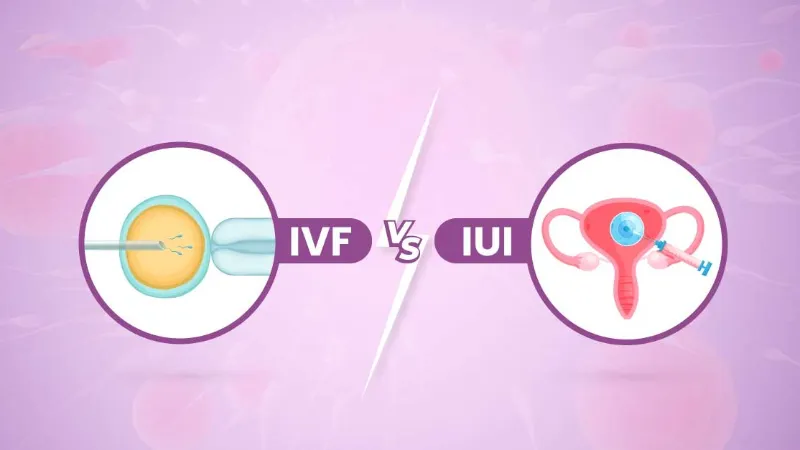
IVF, IUI- Which one is for you and why
For couples struggling with infertility, the journey to parenthood often involves navigating through a maze of options and treatments. In recent years, there has been a significant increase in awareness about fertility treatments and their effectiveness. However, with more treatment options comes confusion and questions for those seeking them.
Differences between Intrauterine insemination (IUI) and In-vitro fertilization (IVF) is commonly misunderstood. As both are assisted reproductive techniques but still they are very different. This also makes them suitable for varied types of individuals or couples.
IUI is a simple procedure which involves placing progressively motile sperm directly into a woman’s uterus during ovulation. This timing is crucial, as it enhances the chances of the sperm reaching the egg during its most fertile phase. The procedure aims to increase the number of sperm that reach the fallopian tubes, thus augmenting the probability of fertilisation. IUI is often the first line of treatment considered in cases of unexplained infertility, mild male factor infertility, or women who have problems with their cervical mucus. It’s also an option for couples who may not be able to engage in regular sexual intercourse for various reasons.
In-Vitro Fertilization (IVF) is a Relatively complex procedure where eggs are fertilized by sperm outside of the body, within a laboratory setting. This process involves controlled ovarian hyperstimulation to grow multiple eggs, which are then retrieved using a needle. Once the eggs are fertilised in the lab, the resulting embryos are monitored for growth before being selected for transfer into the woman’s uterus. IVF is often considered when other less invasive and less expensive fertility techniques have not been successful. It can be an effective option for individuals or couples facing a range of fertility issues, including blocked or damaged fallopian tubes or anovulatary cycles or severe male factor disorders. IVF also allows for the possibility of genetic testing of embryos before transfer, which can be beneficial for those with genetic disorders or recurrent pregnancy loss.
While both IUI and IVF aim to increase the chances of pregnancy, their success rates vary. IUI has a success rate of upto 20% per cycle, depending largely on the woman’s age and the underlying cause of infertility. On the other hand, IVF has a significantly higher success rate, typically around 50% for women under 35, and about 30% for women over 40.
IUI is a less invasive procedure compared to IVF. It involves placing selected active sperms energized with media directly into a woman’s uterus during ovulation. IVF, however, is more complex, involving multiple steps – controlled ovarian hyperstimulation, egg retrieval, fertilisation in a lab, embryo monitoring and transfer (fresh or frozen).
IUI and IVF have specific eligibility criteria. IUI is suitable for individuals with unexplained infertility, mild male infertility, or problems with cervical mucus. It’s also useful for couples who can’t have regular intercourse. IVF, in contrast, is recommended for severe male infertility, blocked or damaged fallopian tubes, ovulation disorders, and those seeking genetic testing for embryos. It’s crucial to consult with a fertility specialist to understand which treatment is ideal for your specific circumstances. As IUI is less complex than IVF, it is typically less costly. However, the success rate of IUI is also lower, which means that multiple attempts may be required, potentially increasing the overall cost. IVF, though more expensive, generally has a higher success rate per cycle.
Both procedures carry some risk. IUI can lead to a higher chance of multiple pregnancies if combined with fertility drugs. IVF, on the other hand, carries risks associated with egg retrieval and embryo transfer procedures, plus the potential for multiple pregnancies. The time commitment required for each procedure is significant. IUI involves less intervention and is typically quicker, allowing for less disruption to daily life. IVF requires more visits to the clinic, additional medication, and a higher emotional investment due to the intensive nature of the treatment. When considering these treatments, practical matters such as distance to the clinic, available time off work, and emotional support systems should also be taken into account. Both procedures are demanding in different ways, and having a strong support system is crucial.
To conclude, there is no ‘one-size-fits-all’ approach to fertility treatment. The choice between IUI and IVF should be made in consultation with a fertility specialist as every person’s fertility journey is unique. It is also essential to remember that there are alternative treatment options available and it’s vital to have open communication with your doctor to find the best option for your circumstances.
Remember, every person’s fertility journey is unique, and there is no shame in seeking assistance on the path to parenthood. Let us support each other on this journey towards creating a family. So let’s break the stigma surrounding infertility and start talking about it openly and with compassion