
Which Fertility Treatment Is Right for You: IVF, IUI or ICSI?
People who seek fertility treatments usually discover three options, which are IVF, IUI and ICSI. The definitions of each treatment create confusion, which leads to most people feeling overwhelmed. The answer to this question depends on your personal health requirements. Many couples feel this way at the start. The IUI procedure provides an affordable option that operates through its straightforward process.
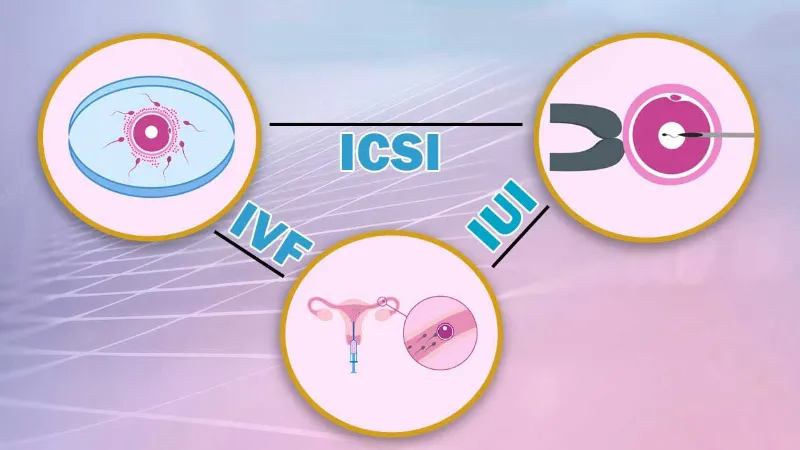
Intrauterine Insemination IUI represents a medical procedure that deposits prepared sperm directly into the woman's uterus during her ovulation period. The method enables fertilisation to occur without the need to overcome specific obstacles. The IUI procedure takes a few minutes. Most women can return to their normal activities on the same day. IUI costs less than both IVF and ICSI treatments. The IUI treatment shows effective results for couples who face infertility challenges through their irregular ovulation patterns and those who require donor sperm. IUI serves as a treatment option after your tubes remain open and your sperm quality reaches acceptable levels.
IVF or In-Vitro Fertilisation is a process where eggs are taken from the ovaries, fertilised with sperm in a lab, and the resulting embryos are placed back into the uterus.
The method allows doctors to observe all aspects of the procedure because fertilisation occurs outside the human body. The doctors will select the most suitable embryos for transfer.
The procedure provides successful results in this specific medical condition.
The medical procedure becomes an option when IUI fails to produce results, and there are blocked fallopian tubes, decreased ovarian function, endometriosis and advanced age-related fertility decline.
ICSI stands for Intracytoplasmic Sperm Injection. The IVF procedure allows direct sperm injection into an egg by using this method. The procedure becomes effective through ICSI for cases that involve extremely low sperm counts, together with poor motility and difficulty for sperm to reach the egg. ICSI has provided support to couples who face challenges with infertility.
Choosing the Right Treatment is a Guide to Help You Decide:
IUI becomes the first step for couples who have infertility problems, and their fallopian tubes remain open while their sperm quality remains high. IUI is an option.
IVF becomes the recommended solution for patients who experience tube blockages and two failed IUI attempts, and have reserve issues and Age over 35 years. IVF is often recommended in these cases.
ICSI provides a solution for problems that include sperm deficiencies, past fertilization failures and low sperm availability. ICSI can help with these problems.
You must not select a medical treatment based on your friend's or an online forum's advice. Fertility conditions differ for every couple. One solution that benefits one couple might fail to help another couple. Your doctor must perform an assessment. They will explain to you the different choices available. You should present all your inquiries to your specialist. They can give you the information you need. The group will resolve after it has gathered all necessary details.
You deserve a plan that is tailored.