

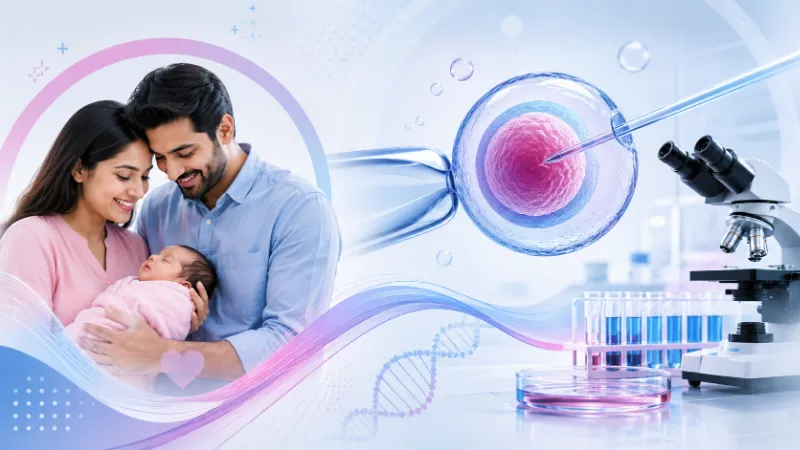
How IVF Continues to Advance in India with Rising Clinical Success Rates
Infertility has emerged as a significant reproductive health concern worldwide, affecting millions of couples across all age groups. In India, the increasing prevalence of delayed parenthood, lifestyle-related disorders, hormonal imbalances, and male factor infertility has led to a growing demand for advanced fertility solutions. Amid these evolving reproductive challenges, In Vitro Fertilization (IVF) has established itself as one of the most scientifically advanced and clinically successful assisted reproductive technologies (ART).
Over the past decade, India has witnessed a remarkable transformation in fertility medicine. With the integration of cutting-edge embryology, precision-driven reproductive protocols, and internationally aligned laboratory standards, IVF treatment outcomes in India have improved substantially. Today, couples seeking IVF Treatment in Delhi have access to highly sophisticated fertility care comparable to global standards.
Understanding the Scientific Foundation of IVF
In Vitro Fertilization (IVF) is a specialized assisted reproductive procedure wherein oocytes (eggs) are retrieved from the ovaries and fertilized with sperm under controlled laboratory conditions. The resulting embryos are cultured, monitored, and subsequently transferred into the uterine cavity to achieve implantation and pregnancy.
IVF is commonly indicated in conditions such as:
- Tubal factor infertility
- Severe male factor infertility
- Polycystic Ovarian Syndrome (PCOS)
- Endometriosis
- Diminished ovarian reserve
- Ovulatory dysfunction
- Unexplained infertility
- Advanced maternal age
Modern IVF protocols are designed to optimize fertilization potential, embryo viability, and endometrial receptivity, thereby enhancing pregnancy and live birth outcomes.
Factors Contributing to Rising IVF Success Rates in India
Advanced Embryology and Laboratory Technologies
One of the most critical determinants of IVF success is the quality of the embryology laboratory. Leading fertility centres in India now utilize highly advanced laboratory infrastructure equipped with:
- HEPA-filtered sterile environments
- Time-lapse embryo incubation systems
- Laser-assisted hatching technology
- Vitrification-based cryopreservation
- AI-assisted embryo assessment
- Blastocyst culture techniques
These innovations have significantly improved embryo selection accuracy and implantation efficiency while reducing the risk of developmental compromise.
A reputed IVF Centre in Tilak Nagar integrates evidence-based laboratory practices to maintain optimal embryo culture conditions and maximize reproductive outcomes.
Personalized Ovarian Stimulation Protocols
Contemporary IVF treatment is no longer based on generalized protocols. Fertility specialists now employ individualized ovarian stimulation strategies tailored according to:
- Anti-Müllerian Hormone (AMH) levels
- Antral Follicle Count (AFC)
- Body Mass Index (BMI)
- Age-related ovarian reserve
- Endocrine profile
- Previous reproductive response
Personalized stimulation minimizes complications such as Ovarian Hyperstimulation Syndrome (OHSS) while improving oocyte yield and embryo quality.
Advancements in Male Infertility Management
Male factor infertility contributes to nearly 40–50% of infertility cases. The introduction of advanced andrology techniques such as:
- Intracytoplasmic Sperm Injection (ICSI)
- IMSI (Intracytoplasmic Morphologically Selected Sperm Injection)
- Surgical sperm retrieval procedures
- DNA fragmentation assessment
has revolutionized treatment outcomes for severe male infertility conditions.
These technologies have substantially increased fertilization rates even in cases involving low sperm count, poor motility, or abnormal sperm morphology.
Enhanced Embryo Selection and Genetic Screening
The implementation of Preimplantation Genetic Testing (PGT) has further improved IVF success rates by enabling the identification of chromosomally normal embryos prior to transfer.
PGT is especially beneficial in:
- Recurrent IVF failure
- Recurrent pregnancy loss
- Advanced maternal age
- Genetic disorder screening
By selecting genetically competent embryos, fertility specialists can improve implantation potential while reducing miscarriage risk.
Improved Cryopreservation Outcomes
Modern vitrification techniques have dramatically enhanced embryo and oocyte survival rates following freezing and thawing. Frozen Embryo Transfer (FET) cycles are now associated with highly favorable pregnancy outcomes due to improved endometrial synchronization and reduced ovarian stress.
This advancement has contributed significantly to cumulative IVF success rates globally and in India.
Rising Awareness and Early Fertility Intervention
Increasing awareness regarding reproductive health has encouraged couples to seek timely fertility evaluation and intervention. Early diagnosis allows fertility specialists to identify underlying reproductive disorders before ovarian reserve declines substantially.
With greater awareness regarding fertility preservation and reproductive planning, more couples are now opting for proactive fertility consultations at specialized centres offering IVF Treatment in Delhi.
The Importance of Multidisciplinary Fertility Care
Modern reproductive medicine extends beyond procedural intervention. Successful IVF outcomes are influenced by a multidisciplinary approach involving:
- Reproductive endocrinologists
- Embryologists
- Andrologists
- Nutrition specialists
- Fertility counselors
- Minimally invasive gynecologic surgeons
Comprehensive fertility care ensures optimized reproductive health, emotional support, and improved patient experience throughout the treatment journey.
India as a Global Destination for IVF Treatment
India has rapidly evolved into a preferred global destination for fertility treatment due to:
- Advanced ART infrastructure
- International-standard fertility laboratories
- Highly experienced fertility specialists
- Cost-effective treatment models
- High clinical success rates
The combination of affordability and clinical excellence has positioned Indian fertility centres among the leading providers of reproductive medicine in Asia.
Conclusion
The evolution of IVF in India reflects the extraordinary progress achieved in reproductive science and assisted conception technologies. Rising clinical success rates are a result of advancements in embryology, precision medicine, genetic screening, individualized treatment planning, and evidence-based fertility protocols.
Today, IVF offers renewed hope to couples facing infertility challenges, transforming parenthood from a distant possibility into a clinical reality. By choosing a technologically advanced and ethically driven IVF Centre in Tilak Nagar, couples can access world-class fertility care supported by scientific precision, compassionate guidance, and comprehensive reproductive expertise.
With continued innovation and patient-centric fertility management, IVF in India continues to stand tall as a beacon of reproductive success and medical advancement.